The mantle has high plasticity because of its heat and pressure.
Is Earth's mantle liquid or solid? Many believe the mantle is liquid rock, but scientists explain that the mantle is actually solid. However, this solid rock can flow and bend over very long periods of time. Understanding this solid-that-flows concept is essential for explaining how Earth's surface changes.
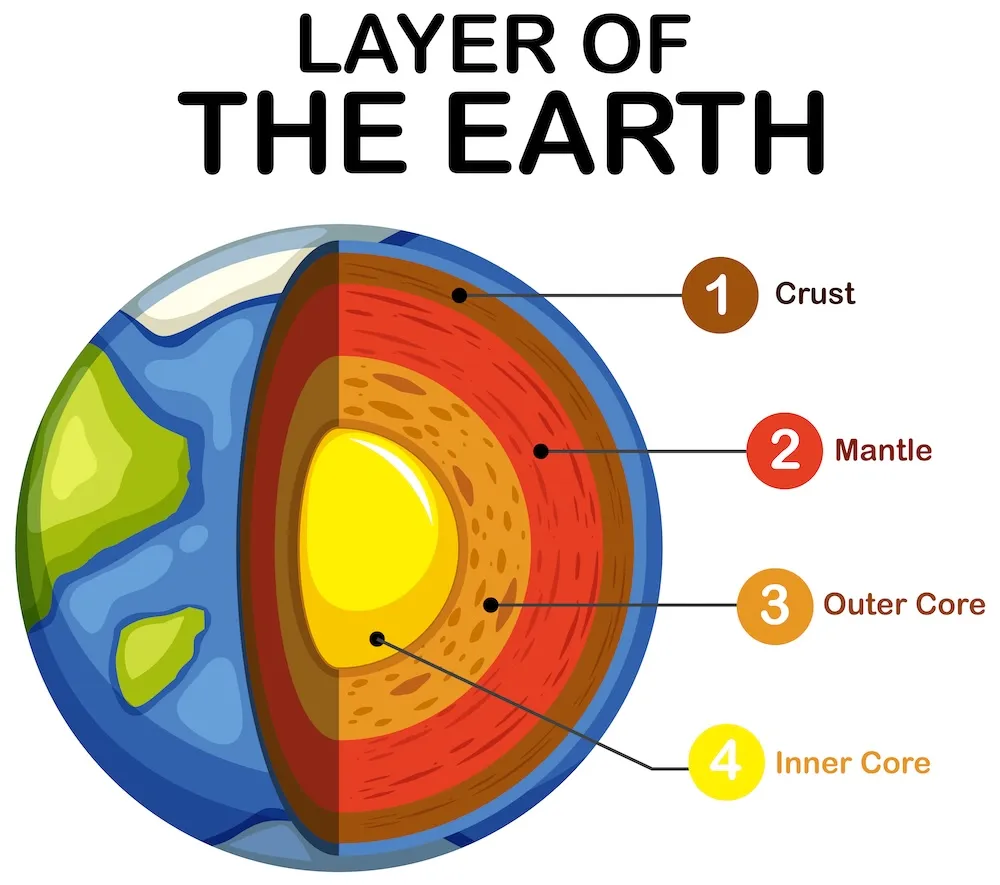
The mantle sits between Earth's crust and core. It extends about 2,900 kilometers deep into our planet. Pressure from the weight of rock above and extreme heat from Earth's core create unusual conditions. Temperatures in the mantle can reach 3,700 degrees Celsius. Under these conditions, solid rock behaves differently than it does at Earth's surface.
Scientists use the term plasticity to describe how solid materials can slowly change shape without breaking. The mantle has high plasticity because of its heat and pressure. Think of silly putty as a comparison. If you hit silly putty quickly, it snaps like a solid. But if you leave it on a table, it slowly oozes and spreads. The mantle works similarly, though much more slowly. Another helpful comparison is a glacier. Glaciers are solid ice, yet they flow downhill over many years. The mantle flows in a similar way, moving just a few centimeters each year.
Evidence shows that mantle rock can flow because of a property called viscosity. Viscosity measures how easily a material flows. Water has low viscosity and flows quickly. Honey has higher viscosity and flows slowly. The mantle has extremely high viscosity, so it flows very, very slowly. Scientists observe this movement by studying seismic waves from earthquakes. These waves travel through Earth and reveal that the mantle is solid, not liquid.
The mantle's ability to flow has real consequences for our planet. In Hawaii, scientists measure how the islands slowly sink into the mantle over time. The weight of the volcanic islands pushes down on the solid mantle below. The mantle rock slowly flows out of the way, allowing the islands to sink about one centimeter every ten years. This process provides direct evidence that solid mantle rock can flow.
Why does this matter? The flowing mantle drives convection currents deep inside Earth. Hot mantle rock slowly rises toward the surface while cooler rock sinks. These currents move the giant tectonic plates that make up Earth's crust. Without the mantle's ability to flow, we would not have earthquakes, volcanoes, or mountain building. The solid mantle's slow movement shapes our planet's surface and makes Earth a dynamic, changing world.
Interesting Fact: Scientists can recreate mantle conditions in laboratories by squeezing rocks with tremendous pressure and heating them to extreme temperatures. In these experiments, solid rocks actually bend and flow, confirming what happens deep inside Earth.
What is the state of matter of Earth's mantle?
LiquidSolidGasPlasma
How fast does the mantle typically move each year?
Several metersA few centimetersMany kilometersIt does not move at all
What does the term 'viscosity' mean in the passage?
How hot something isHow hard something isHow easily a material flowsHow deep something is
Which property allows the mantle to slowly change shape without breaking?
DensityPlasticityMagnetismConductivity
Based on the passage, why can scientists conclude that the mantle is solid and not liquid?
They have drilled down and touched itSeismic waves show it is solidIt looks solid from spaceAncient writings describe it as solid
What causes the mantle to have the ability to flow?
It contains a lot of waterExtreme heat and pressureEarth's magnetic fieldThe pull of the moon
How do the Hawaiian Islands provide evidence that the mantle flows?
They are slowly sinking into the mantleThey are growing taller each yearThey are moving toward JapanThey are getting colder over time
What happens to hot mantle rock in convection currents?
It sinks downIt stays in placeIt rises toward the surfaceIt turns into liquid
True or False: The mantle is liquid rock that flows quickly.
TrueFalse
True or False: Without the mantle's ability to flow, Earth would not have volcanoes or earthquakes.
TrueFalse
Who it's for
Perfect for the way you teach
Teachers
Build comprehension skills
Auto-graded quiz
Differentiated reading
Parents
Read together at home
Improve fluency
Quiet reading time
Homeschoolers
Reading curriculum support
Independent practice
Track Lexile growth
Topics
This 400-500 word reading passage helps middle school students (grades 6-8) understand a common misconception in Earth science: whether Earth's mantle is liquid or solid. Aligned with NGSS standards MS-ESS2-1 and MS-ESS2.Athe passage explains that the mantle is solid rock that can flow like a very thick fluid over enormous time spans due to extreme heat and pressure. Students learn about viscosityplasticityand how scientists use evidence to understand mantle behavior. The passage includes real-world examples like silly putty and glaciers to help students grasp this challenging concept. Audio-integrated content supports diverse learners. Activities include multiple-choice questionswriting promptsand graphic organizers that reinforce understanding of how the solid mantle's ability to flow enables plate tectonics and convection currents that shape Earth's surface.
Reviews & Ratings
No reviews yet. Be the first to share your experience!
More reading you might love
20 more
Talus Slopes: Formation and Features
MS-ESS2-1MS-ESS2-2RST.6-8.4
FREE
Biological Weathering: Types and Examples
MS-ESS2-1MS-PS1-2RST.6-8.3
FREE
Frost Wedging: How Ice Splits Rock
MS-ESS2-1MS-ESS2-2RST.6-8.3
$1.50
Chemical Weathering: The Breakdown of Rocks Through Chemical Reactions